
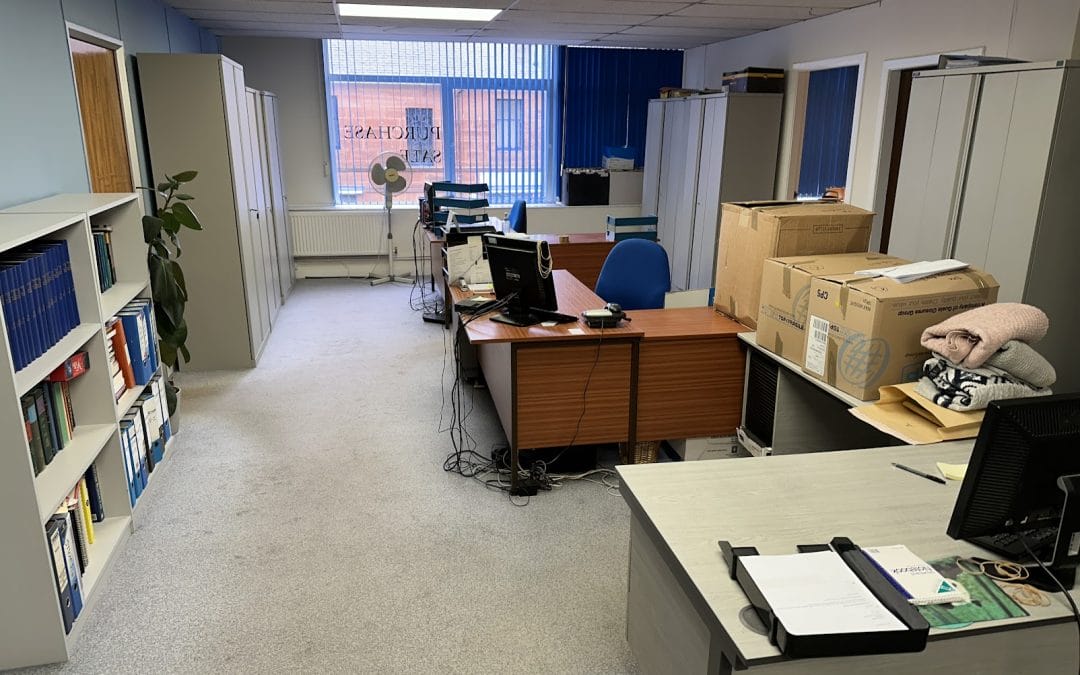
An office clearance follows a fairly predictable path: you fix a date, the clearance company surveys the space, you agree what stays and what goes, IT and confidential paper are dealt with securely, reusable furniture finds a new home, and the rest is removed, recorded and swept up. Knowing each stage in advance makes it far easier to plan around your staff, your landlord and your clients.
This guide sets out what to expect at every step, whether you are clearing one floor in Glasgow city centre or a whole business unit. If you are still at the earlier stage of planning a relocation, our guide to planning an office move with a professional clearance service covers the weeks before you go.
Step 1: Fix your deadline and work backwards
Start with the date the space has to be empty. That might be the end of your lease, the day a new tenant gets the keys, or the date a refurbishment contractor needs to start. Once you know it, work backwards and build in a buffer. Clearances often uncover more than anyone expected, such as a basement full of archive boxes. If the lease requires partitions, ceilings or flooring to be taken out, our dilapidation works can be planned alongside the clearance.
Allow time for quotes too. A week is a sensible minimum to have a clearance company look at the job and price it properly. Rushing it limits how many firms you can compare and leaves less time to arrange resale or donation of good furniture.
Step 2: The site survey
A reliable quote depends on someone seeing the job, either in person or through clear photos and video. During the survey the clearance team will look at:
- The volume and type of items: desks, chairs, filing cabinets, partitions, IT equipment, kitchen appliances and general clutter.
- Access: lifts, stairwells, loading bays and how far items need to be carried. Older buildings in Glasgow and Edinburgh often have narrow common stairs and no lift, which affects how many people the job needs.
- Parking and loading: city centre streets often have tight restrictions.
- Building rules: many managed buildings set times for using the goods lift.
- Anything the company cannot take. A reputable firm will tell you plainly if there are chemicals, asbestos or other hazardous materials that need a specialist contractor.
Step 3: Build an inventory of what stays and what goes
Before removal day, walk through the office and decide the fate of every significant item. A simple system works well: one coloured label for items moving to the new premises, another for items being cleared, and a third for anything still undecided. Keep a written list alongside the labels.
Check a few things that are easy to miss:
- Leased equipment, such as printers, copiers and water coolers, which usually goes back to the supplier rather than out with the clearance.
- Fixtures and fittings that belong to the landlord and must stay.
- Staff belongings left in drawers, lockers and coat cupboards.
Step 4: Schedule the work around your business
Most businesses want to keep disruption to a minimum. Some offices clear one floor or department at a time, while others prefer the whole job done after staff have moved out. If you would like the work done in the evening or at a weekend, raise it at the quote stage so it can be agreed with your building management. Let staff and neighbouring tenants know when the work is happening.
Step 5: IT equipment and data security
Old computers, laptops, phones and servers need careful handling. Under UK GDPR, organisations must keep personal data secure, and that duty does not end when the equipment is no longer in use. Hard drives should be securely wiped or physically destroyed, with a certificate to show it was done. Check whether other devices, such as copiers and phones, hold any data before they leave the building. Our hard drive and IT disposal service is designed for exactly this.
If you have fixed air conditioning, the refrigerant gas must be recovered by a technician qualified to work with F-gas before the units are taken out. Arrange this well before clearance day.
Step 6: Confidential paperwork
Decide which records you need to keep, which can be archived and which can be destroyed. Paper containing customer, staff or financial information should never go out with general waste or loose in the recycling. BS EN 15713 is the code of practice for the secure destruction of confidential material, so ask any provider how they meet it. Keep it in locked consoles or sealed sacks until collection, and use a dedicated confidential waste disposal service for anything sensitive.
Step 7: Find new homes for furniture and equipment
Good office furniture does not have to be thrown away. You can move it to your new premises, offer it to staff, donate it to charities and community groups, or sell it. Be realistic about resale: the second-hand office furniture market is slow, and large matching sets in good condition sell far more easily than a mixed collection.
Whatever cannot be reused should be recycled. Businesses in Scotland must present glass, metal, plastic, paper and card for separate collection under the Waste (Scotland) Regulations 2012, and an office move usually produces a mountain of cardboard. Our guide to cardboard waste collection in Glasgow explains how to handle it.
Step 8: Removal day, paperwork and the final sweep
On the day, the team should arrive as agreed, dismantle larger furniture where needed, lift carpets and flooring if that is part of the job, and load everything safely. Once the space is empty, a final sweep and tidy leaves it ready for handover.
Paperwork matters as much as the physical work. As a business, you have a duty of care for your waste: you must only give it to an authorised person, such as a waste carrier registered with SEPA, and you must complete a waste transfer note for what is handed over. Check any carrier on the SEPA public register before you book. NetRegs has a clear summary of the duty of care for businesses in Scotland.
How Jettison Express can help
Jettison Express provides office clearances in Glasgow and across central Scotland, covering Edinburgh, Stirling, Perth, Dundee, Paisley and the surrounding areas. Our team brings more than 65 years of combined industry experience and over 780 completed projects. We will:
- Give you up-front rates and call ahead when the team is on its way.
- Send friendly, uniformed staff to dismantle, carry and load.
- Take everything to our depot to be sorted for recycling, with a recycling rate of over 90%.
- Leave the space swept and tidy, with the paperwork completed.
We hold ISO 9001:2015 and ISO 14001:2015 accreditation, are SafeContractor approved and are a Living Wage Employer. We remove non-hazardous waste only, so we will tell you at the survey stage if anything needs a specialist. If your business is in the capital, see our office clearance service in Edinburgh.
Planning an office clearance? Contact Jettison Express for a free, no-obligation quote, or call us on 0333 880 6800, Monday to Friday, 8am to 6pm.
Frequently asked questions
How long does an office clearance take?
It depends on the size of the office, how much is being removed, access to the building and how much sorting has been done beforehand. A small office might be cleared in a single visit, while a large multi-floor building may need several days or a phased approach. A site survey is the best way to get a realistic timescale for your premises.
Do I need a waste transfer note for an office clearance?
Yes. Businesses in Scotland have a duty of care for their waste. You must only pass it to an authorised person, such as a waste carrier registered with SEPA, and complete a waste transfer note for the waste handed over. Keep a copy with your business records and check your carrier on the SEPA register before booking.
What happens to old computers and hard drives?
Under UK GDPR you must keep personal data secure, including when you dispose of IT equipment. Hard drives should be securely wiped or physically destroyed, with a certificate as proof. The equipment itself is electrical waste and should go through proper recycling routes rather than general waste.
Will you take hazardous waste or asbestos during an office clearance?
No. Jettison Express removes non-hazardous waste only. Chemicals, asbestos and other hazardous materials need a licensed specialist contractor. If we spot anything of concern during the survey, we will let you know so you can arrange the right contractor before clearance day.