
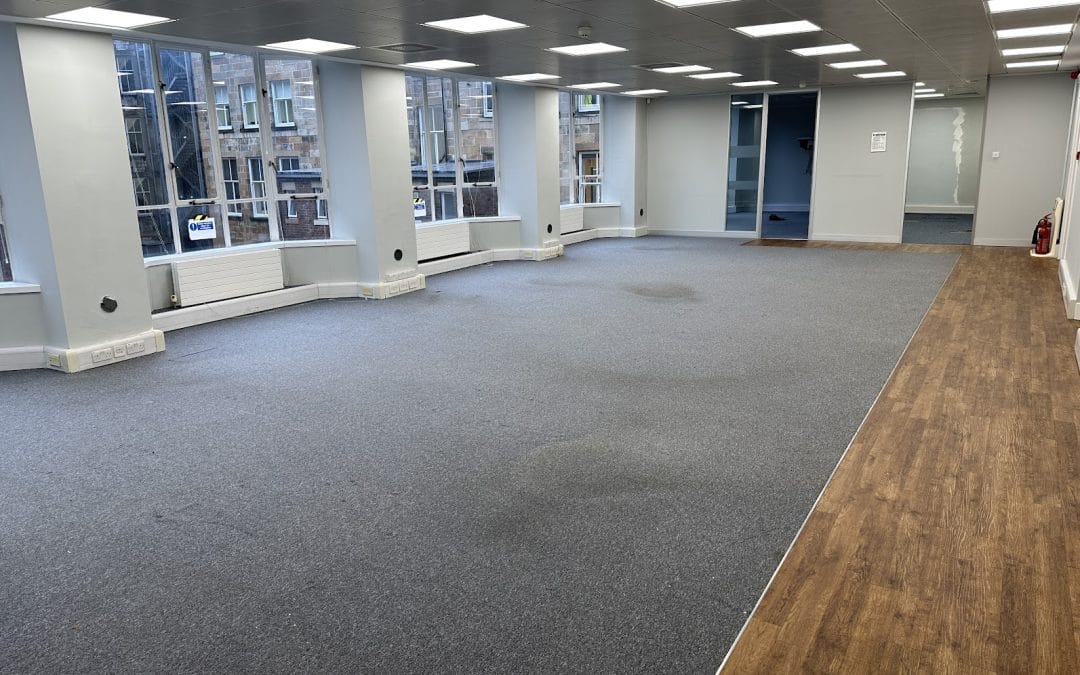
If your office is moving, a professional clearance service takes the heaviest and riskiest part of the move off your hands: emptying the old premises, dealing with everything that is not coming with you, and making sure it is disposed of legally. That leaves your team free to focus on the new space and on keeping the business running.
Many Scottish businesses have rethought their premises since hybrid working became the norm. Some are downsizing to a smaller office, some are consolidating sites, and others are moving to a building that suits the way they work now. Whatever the reason, an office move almost always produces far more unwanted furniture, equipment and paper than anyone expects. This guide explains why it pays to bring in professionals and gives you a simple timeline to work to.
Why an office move needs more than a removal van
Clearing a home before a move usually means a few unwanted items. Clearing an office is different. Years of accumulated desks, chairs, filing cabinets, IT equipment, archive boxes and kitchen appliances all need a destination, and many of them come with rules attached:
- Duty of care. Every business must only give its waste to an authorised person, such as a waste carrier registered with SEPA, keep that waste contained and complete waste transfer notes. If waste you paid someone to remove is later fly-tipped, your business can be held responsible.
- Recycling obligations. Businesses in Scotland must present glass, metal, plastic, paper and card for separate collection under the Waste (Scotland) Regulations 2012.
- Data protection. Under UK GDPR, personal data must be kept secure, including on old computers and in paper files you no longer need.
A professional clearance company handles all of this as part of the job, with the paperwork to prove it. NetRegs sets out the full duty of care for businesses in Scotland if you want the detail.
Your office move clearance timeline
Every move is different, but working to a rough timeline stops the clearance being left until the last few days.
Eight weeks before the move
- Confirm the date you must hand back the old premises and check what condition the lease requires it to be left in.
- Measure the new space and decide how much furniture will actually fit. If you are downsizing, this is where most of your clearance list comes from.
- Ask for clearance quotes. A survey of the premises gives the most accurate price and lets the company plan access, parking and the size of team needed.
- Start a records review: which paper files must be kept, which can be scanned and which can be securely destroyed.
Four weeks before the move
- Label every item as moving, clearing or undecided, and push for decisions on the undecided pile.
- Offer surplus furniture to staff, charities or buyers. Large sets of matching furniture in good condition are the easiest to rehome.
- Book secure hard drive and IT disposal for redundant computers, servers and phones.
- If you have fixed air conditioning that is staying behind or being scrapped, arrange for a technician qualified to work with F-gas to recover the refrigerant before anything is removed.
- Return leased equipment, such as copiers and water coolers, to the supplier.
One week before the move
- Confirm the clearance date, start time and access arrangements with the clearance company and your building management.
- Arrange confidential waste disposal for paper files, and keep them secure until they are collected.
- Remind staff to clear personal belongings from desks, lockers and the kitchen.
- Plan for packaging waste. A move generates a great deal of cardboard, and our guide to cardboard waste collection in Glasgow explains how to keep it under control.
For a closer look at what happens on the day itself, read our step by step guide to the office clearance process.
Work out what you are getting rid of, and how much
Two questions shape every office clearance quote: what type of waste is there, and how much? Furniture, IT equipment, paper, kitchen appliances and general clutter all follow different routes, so separating them early helps you see which items will need the most care. Volume matters because it drives how many people and vehicles the job needs. Giving the clearance company an accurate picture, ideally through a survey, means a fair quote and no surprises on the day.
Keeping downtime to a minimum
The real cost of a badly planned move is lost working time. A few simple choices help:
- Phase the clearance floor by floor or team by team, so most staff can keep working.
- Ask whether the work can take place in the evening or at a weekend, and agree it early with your building management.
- Clear the old premises after the move into the new one, rather than before, so nobody is working among half-empty rooms.
- Have one named person on site who knows the plan and can answer questions.
Use the move to start afresh
A move is the perfect moment to leave clutter behind. There is little point paying to transport furniture you do not need or files nobody will read again. Arriving in a tidy, well-organised space also helps people settle in faster. We look at the wider benefits in our article on why organised workspaces matter.
How Jettison Express can help
Jettison Express carries out commercial office clearances across Scotland, from small offices to larger multi-room premises. Our uniformed team will dismantle larger furniture, lift carpets and flooring where needed, load everything safely and finish with a sweep and tidy. All waste goes to our depot to be sorted for recycling, and our recycling rate is over 90%. We give up-front rates, call ahead when we are on our way and leave the paperwork with you once the job is complete.
We are ISO 14001:2015 accredited for environmental management and SafeContractor approved. We remove non-hazardous waste only, so anything such as chemicals or asbestos will need a specialist contractor. For businesses in and around the city, see our office clearance service in Glasgow.
Planning an office move? Get in touch with Jettison Express for a free quote, or call 0333 880 6800, Monday to Friday, 8am to 6pm.
Frequently asked questions
How far in advance should I book an office clearance?
As early as you can. Starting around eight weeks before your move gives time for a site survey, comparing quotes, rehoming good furniture and arranging secure disposal of IT and paper records. Leaving it until the final week limits your choice of contractor and makes it more likely that reusable items end up as waste.
Is my business responsible for waste removed during an office move?
Yes. Under the duty of care, your business must only give waste to an authorised person, such as a SEPA registered waste carrier, and complete waste transfer notes. If waste you paid an unauthorised collector to remove is fly-tipped, your business can be held responsible, so check the carrier on the SEPA register first.
What should we do with office furniture we no longer need?
Start with reuse: move it to the new premises if it fits, offer it to staff, donate it or sell it. Large matching sets in good condition are the easiest to rehome. Anything left over can be removed by a clearance company, which should sort it for recycling rather than sending it straight to landfill.
Can you clear our old office after we have moved out?
Yes, and it is often the best approach because it keeps disruption to a minimum. Once your team has moved, the old premises can be cleared, swept and left ready for handover. Let us know your lease end date when you ask for a quote so the timing can be planned properly.