
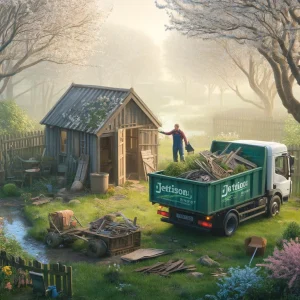
An old garden shed with a leaking roof and rotten floor takes up space you could use for something better. Removing it means emptying it, checking the roof for asbestos, taking it apart safely, and disposing of the timber, felt, glass and base properly. You can do it yourself with the right tools, a helper and a way to move the waste, or a clearance team can dismantle and remove the whole thing in one visit. This guide covers both, starting with the checks that matter most.
Signs it is time for the shed to go
- The floor is soft or the bottom of the walls has rotted where they meet the ground.
- The roof leaks, even after re-felting.
- The door no longer closes and the frame has started to lean.
- Rats or mice are living under the floor.
- You want the space for a new shed, a garden room, a patio or simply more lawn.
Check for asbestos before you touch the roof
This is the most important step, especially in older Scottish gardens. The UK banned asbestos in 1999, so any shed, garage or outbuilding built before 2000 could contain asbestos cement roofing or wall panels. Grey corrugated roof sheets on older sheds are the most common example, but you cannot tell for certain just by looking.
If there is any chance your shed contains asbestos:
- do not break, cut, drill or snap the sheets
- do not throw them in a skip or take them to the tip with other waste
- use a licensed asbestos contractor, or ask your council about disposal
Jettison Express does not remove asbestos or other hazardous waste. Once a licensed contractor has dealt with any asbestos, we can remove the rest of the shed and its contents.
Empty the shed first
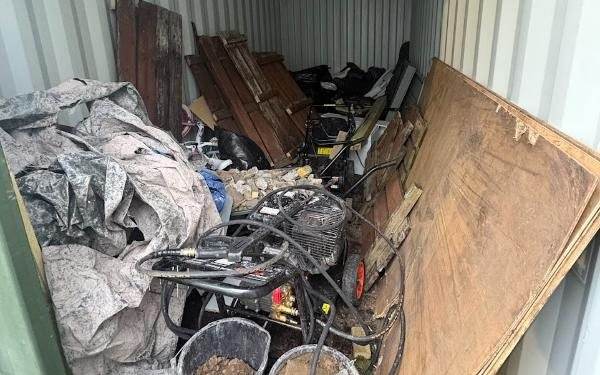
Go through the contents before anything is dismantled. Take out tools, bikes, mowers and anything you want to keep or sell. Old paint, oil, car batteries and gas cylinders should not go in with the shed waste; Glasgow residents can take these to a household waste recycling centre. Look out for wasps' nests in summer and nesting birds under the eaves in spring. Everything else, from broken furniture to decades of odds and ends, can go with the shed. If the garage needs the same treatment, our garage clearance service in Glasgow handles both together.
How a shed is taken down
Most timber sheds come apart in roughly the reverse order they were built:
- Power off. If the shed has an electricity supply, have an electrician disconnect it safely before anything else.
- Windows and glass. Remove glass or plastic glazing first so it cannot shatter when the panels move.
- Roof covering. Strip the felt or shingles, then lift the roof boards. Work from a stable platform, not from the shed itself.
- Walls. Unscrew or unbolt the panels from each other. Rotten panels can collapse suddenly, so two people make this much safer.
- Floor and bearers. Lift the floor and any timber bearers underneath, watching for nails and anything living below.
Wear thick gloves, eye protection and sturdy boots throughout. Old sheds are full of rusty screws and nails, and splintered timber can cut deeply.
What happens to the materials
Most of a timber shed can be recycled if it is separated properly. Clean, untreated timber can be processed into products such as panel board or used as biomass fuel. Treated timber needs the right recycling route and should never be burned at home, because of the fumes. Roofing felt and plastic are stripped away from the wood, glass is kept apart, and hinges, bolts and metal fixings go for scrap.
At Jettison Express, everything we collect goes back to our depot to be sorted, which is how we recycle over 90% of what we take away. If you are also replacing a fence or deck, our guides to disposing of old fence panels and getting rid of old decking wood cover those materials in detail.
Do not forget the base
Once the shed is gone, you are left with whatever it sat on: paving slabs, a concrete pad or timber bearers on gravel. Slabs in good condition can be lifted and reused for a path or patio. A concrete base is heavy work to break out, so mention it when you ask for a quote. Remember that soil, rubble and bricks cannot go in Glasgow's brown bin.
Your options for getting rid of an old shed
- Do it yourself. Glasgow's recycling centres accept wood, but a dismantled shed is several car loads, and vans are only accepted at Shieldhall and Dawsholm at set times.
- Skip hire. Useful if you have other waste too, but a skip on a public road in Glasgow needs a permit, from £55 for the first week outside the city centre or £92 in the city centre, and you still dismantle and load everything.
- A clearance company. The team dismantles the shed, clears its contents and takes everything away in one visit.
How Jettison Express can help
Jettison Express removes old sheds as part of our garden clearance service in Glasgow and across central Scotland. We dismantle the shed, take away its contents, and can clear the rest of the garden at the same time. If there is household junk to go as well, our junk removal service covers that in the same visit. We give you an up-front rate, call ahead when we are on our way, and finish with a sweep and tidy. We remove non-hazardous waste only, so any asbestos must be dealt with by a licensed contractor first. For an overview of the whole process, see what to expect from a professional garden clearance.
To get rid of an old shed without the hard work, contact us for a no-obligation quote or call 0333 880 6800, Monday to Friday, 8am to 6pm.
Frequently asked questions
How do I know if my shed roof contains asbestos?
You cannot be sure just by looking. The UK banned asbestos in 1999, so any shed built before 2000 could have asbestos cement roofing or panels, often grey corrugated sheets. If in doubt, treat the material as if it contains asbestos, do not break or cut it, and use a licensed contractor or ask your council for advice.
Can you take away a shed that has already been taken down?
Yes. We can collect the panels, roof felt, timber and anything that was stored inside, whether the shed is still standing or already in pieces. As long as there is no asbestos, we load everything ourselves and take it back to our depot for sorting and recycling.
Can old shed wood be recycled?
Yes, in most cases. Clean, untreated timber can be recycled into products such as panel board or used as biomass fuel once felt, glass and metal fixings have been removed. Treated timber needs the right recycling route and should not be burned at home. A clearance company will separate the materials for you.
Do I need to empty my shed before it is removed?
Take out anything you want to keep, plus paint, oil, car batteries and gas cylinders, which Glasgow residents should take to a recycling centre. Everything else can usually stay, as a clearance team can remove the contents along with the shed. Let them know what is inside when you ask for a quote.