
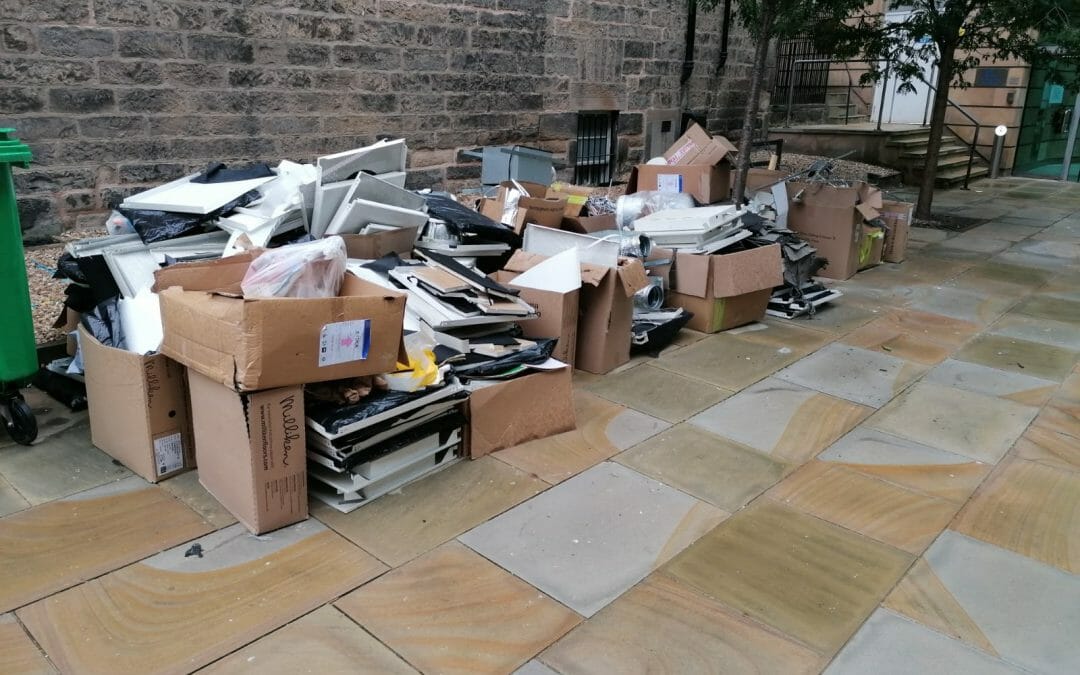
To clear a tenement flat in Glasgow, plan the route before you lift anything: measure the tightest turn on the stair, dismantle beds and wardrobes inside the flat, protect the banisters, and carry every item straight out to a waiting vehicle. Nothing should be left in the close, on the landings or in the back court, even for an hour. Many people find it easiest to book a team used to tenement stairs, so the flat is emptied in one organised visit.
Tenements are some of the best homes in the city, from the red sandstone streets of the Southside to the closes of Partick and Dennistoun. They were also built long before anyone tried to get a corner sofa down three flights of stone stairs. We carry out tenement and flat clearances across Glasgow, and this guide sets out how to do it safely, legally and without falling out with the neighbours.
What makes clearing a tenement flat different?
Clearing a house with a driveway is mostly a question of volume. In a tenement, access is the real challenge:
- The common stair. Everything goes down the shared close, usually stone steps with a turn at every half landing.
- No lift. Most traditional tenements have no lift, so a top floor flat means several flights for every load.
- Tight turns, not tight doors. The flat door is rarely the problem. The turn at the half landing, the banister and the close entrance usually are.
- Shared spaces. The back court and bin store belong to everyone in the block.
- Parking. Tenement streets are often lined with cars, some sit in controlled parking zones, and the carry to the van can be long.
How do you get furniture out of a tenement flat?
Make every item as small and light as possible before it reaches the stair:
- Measure the tightest point. Measure the half landing turn and the close entrance, not just the flat door. A wardrobe that leaves the flat can still jam on the first turn.
- Dismantle in the flat. Beds, wardrobes, tables and flat pack units should come apart inside.
- Empty everything. A full chest of drawers is heavy, and drawers slide out on the stairs.
- Remove feet, cushions and doors. Taking the legs off a sofa or the doors off a unit often gains the few centimetres you need.
- Protect the stair. Blankets on the banister and corners prevent scrapes to the paintwork and tiles of a wally close.
- Carry in pairs. Heavy items need two people, one above and one below.
- Load straight onto the vehicle. Items go from the flat to the van in one movement, never staged in the close or on the pavement.
What if a sofa will not fit down the stairs?
This is the most common tenement problem. Remove the feet, the cushions and any detachable back or arms first. Then stand the sofa on its end and pivot it around the turn, which gains far more room than carrying it flat. Sofa beds are heavier than they look, so take the mattress out where you can.
If it still will not go, stop before anyone reaches for a saw. In Scotland, waste upholstered seating such as sofas, sofa beds and armchairs may contain persistent organic pollutants (POPs). It has to be incinerated rather than landfilled, and it must not be torn up or mixed with other waste. A team used to tenement stairs will know how a particular frame can be handled, so ask before you cut anything.
Can I leave furniture in the close or back court?
No. This is the most important rule on any tenement clearance.
Why the close and stair must stay clear
The Scottish Fire and Rescue Service and housing associations advise keeping closes and common stairs clear at all times. The common stair is often the only way out of the building in a fire, and items left in the close can be set alight deliberately. A mattress at the foot of the stair, even for one night, puts every household above it at risk.
Why the back court is not a holding area
Leaving furniture or bags in the back court, beside the bins or on the pavement can be treated as fly-tipping. In Scotland the fixed penalty for fly-tipping is £500, and on conviction the fine can reach £40,000. Our guide to fly-tipping and the rules around it explains more.
Only give your waste to an authorised person, such as a waste carrier registered with SEPA (you can check SEPA's public register). If you pay someone unregistered and your belongings are dumped, you can be held responsible.
Do I need permission from the factor or neighbours?
In most cases you do not need anyone's permission to carry your own belongings out of a flat. Good manners go a long way in a shared building, though:
- Tell your neighbours. A note through the doors a few days before, with the date and rough timing, lets anyone with mobility needs plan around it.
- Speak to the factor if you are unsure. Your factor looks after the common parts. Check with them about any building rules for the stair, back court or bin store, or if repair work is under way in the close.
- Look after the close door. Propping the security door open for hours worries neighbours, so close it between loads.
Is a skip a good idea for a tenement flat?
Usually not. Most tenement streets have no driveways, so a skip has to sit on the road. That needs a council skip permit (in Glasgow in 2026/27, from £55 for the first week outside the city centre and more in the city centre), and it takes up parking your neighbours rely on. Open skips also tend to fill up overnight with other people's rubbish.
A skip will not solve the stair either. You still carry every item down yourself, and sofas and armchairs need separate handling because of the POPs rules. Our comparison of house clearance versus skip hire sets out the pros and cons.
For small amounts, the council's household waste recycling centres are an option. They are for residents, and rules on vans, booking and permits vary, so check before you go. Good furniture can also be passed on through Zero Waste Scotland's reuse service.
Clearing a tenement flat at the end of a tenancy
Glasgow has a lot of rented tenement flats, and the end of a tenancy is a common reason for a clearance. Landlords often need old furniture, carpets and leftovers removed before the flat can be cleaned and relet. A void property clearance handles that in one visit.
If the flat was a council or housing association home and the tenant has died, the landlord will normally expect the belongings to be removed so the property can be returned. Anyone who qualifies to take over a Scottish secure tenancy but does not want it must tell the landlord in writing within four weeks of the death, so ask the landlord about timescales early.
Your tenement clearance checklist
- Decide what you are keeping and move it into one room, or take it away beforehand.
- Remove personal papers, photographs, medicines and valuables first.
- Measure the stair turn, tell the neighbours and check where a van can stop.
- Find keys for the back court, bin store and any cellar.
- Remember the hall press, the cellar and any space above the cupboards.
- Use a registered waste carrier and get the rate agreed before work starts.
How long does it take to clear a tenement flat?
As a rough guide, a one bedroom flat often takes a few hours and a larger, fuller flat can take most of a day, but every property is different. A top floor flat with tight turns takes longer than a main door flat with the van outside. Our guide to how long a house clearance takes has more detail.
How Jettison Express can help
Jettison Express is a Glasgow clearance company based in the east end, clearing flats across the city and beyond, from tenement flats in Shawlands to flats and houses in Rutherglen. On a tenement job you can expect:
- An up-front rate agreed before any work starts.
- A uniformed, insured team who call ahead on the day.
- Furniture dismantled in the flat and carpets lifted.
- Items carried straight to our vehicle, never left in the close.
- A sweep and tidy of the cleared flat at the end.
- Everything taken to our Glasgow depot and sorted, with over 90% reused or recycled.
- A registered waste carrier, with paperwork left once the job is complete.
We do not remove asbestos or hazardous waste such as paints and chemicals, so mention anything like that when you ask for a quote.
If you have a tenement flat to clear, get in touch for a quote or call us on 0333 880 6800. Photos of each room and a note of which floor the flat is on help us give you an accurate rate.
Frequently asked questions
How do you get furniture out of a tenement flat?
Measure the tightest turn on the stair and the close entrance, not just the flat door. Dismantle beds and wardrobes inside the flat, empty all drawers, and take the feet and cushions off sofas. Protect the banister, carry heavy items in pairs, and load everything straight onto the vehicle rather than leaving it in the close.
Can I leave furniture in the close or back court?
No. Scottish fire safety advice is to keep closes and common stairs clear, because the stair is often the only way out in a fire and items left there can be set alight deliberately. Furniture left in the back court or beside the bins can be treated as fly-tipping, which carries a £500 fixed penalty in Scotland.
Do I need permission from the factor or neighbours to clear a tenement flat?
Usually you do not need permission to remove your own belongings. It is still good practice to tell your neighbours the date and rough timing a few days before, and to check with the factor if there are building rules about the common stair, back court or bin store, or if work is already going on in the close.
What if a sofa will not fit down the tenement stairs?
Remove the feet, cushions and any detachable back or arms, then stand the sofa on its end and pivot it round the turn. If it still will not go, do not cut it up. In Scotland waste upholstered seating may contain POPs and must not be torn up or mixed with other waste, so ask an experienced clearance team how to handle it.
Is a skip a good idea for a tenement flat?
Usually not. Tenement streets rarely have driveways, so a skip needs a council road permit and takes up neighbours' parking. Open skips often fill with other people's rubbish, you still have to carry everything down the stair, and sofas need separate handling. A clearance team that carries and loads for you is usually simpler.